Traditional medicine has supported community health for generations in Uganda. Yet much of this knowledge remains undocumented, invisible to the global scientific community. Bridging the gap between indigenous knowledge and modern science is at the heart of CARTA graduate Godwin Anywar’s work. A Lecturer at Makerere University, his research focuses on indigenous medicinal plants, particularly their role in supporting people living with HIV/AIDS. With more than 1.4 million Ugandans living with HIV, many people use traditional herbal remedies alongside conventional treatment to help manage symptoms and support their well-being.
Although many modern medicines have their origins in natural products, relatively little scientific evidence exists for many of the medicinal plants commonly used in HIV care. At the same time, despite decades of research, an effective cure for HIV remains elusive. This combination of widespread community use, limited scientific validation, and the need to identify new therapeutic compounds inspired Godwin to pursue a career in ethnopharmacology and natural products research.
During his CARTA-supported doctoral studies, Godwin worked closely with traditional healers, documenting the plants they use to support people living with HIV/AIDS. He then took this knowledge into the laboratory, testing the plants for antiviral activity against HIV, examining their effects on the human immune system, and assessing their safety and potential toxicity. His research identified several medicinal plant species with promising antiviral activity against HIV-1 in laboratory studies. In doing so, he demonstrated how indigenous knowledge and modern science can complement one another, generating evidence that advances both scientific understanding and recognition of traditional medicine.
From Local Knowledge to Global Platforms
Godwin’s participation in the CARTA PhD fellowship was pivotal to his career, helping him build connections within international scientific communities. CARTA supported his participation in his first international conference outside Africa, where he received the Global Young Investigator Award from the International Society for Ethnopharmacology. The award significantly raised his profile, opening doors to international collaborations and establishing him as an emerging expert in medicinal plants and indigenous knowledge. Since then, he has been invited to speak at global conferences and to supervise, mentor, and examine doctoral students from around the world. What began as locally grounded research has grown into a globally recognized body of work.
Additionally, he has taken on editorial and advisory roles across several international journals, including PLOS ONE, Frontiers in Pharmacology (Ethnopharmacology), Discover Molecules (Springer Nature), and BMC Complementary Medicine and Therapies (Springer Nature), positions that place him at the center of global scientific discourse on medicinal plants and ethnopharmacology.
Research That Reaches Communities
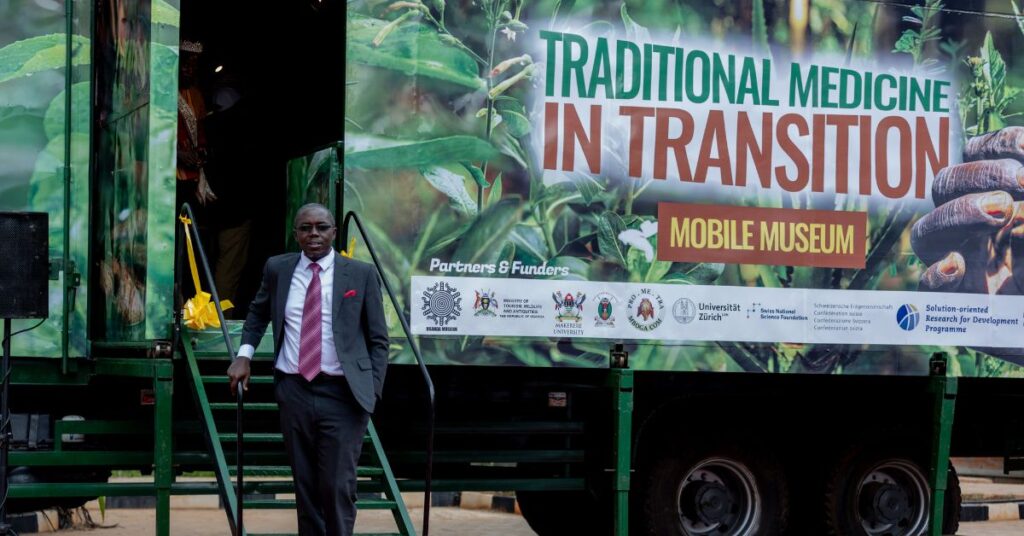
Godwin’s work extends far beyond the lab. As the Principal Investigator on a project funded by the Swiss National Science Foundation (SNSF), he documented the evolution of traditional medicine in Uganda. One of the project’s most impactful outputs is a traveling mobile museum—an exhibition of artifacts, knowledge, and practices collected during the research. The museum also involves various practitioners and practices, including herbalists and other traditional healers. In 2025, the team embarked on a three-month journey across Uganda with the mobile museum, sharing their research findings directly with communities.
For many Ugandans, especially school children, the museum was a unique experience. The initiative not only made research accessible but also fostered appreciation of cultural knowledge systems. Its success led to an extended exhibition period of another three months by the Ministry of Tourism and sparked interest from the tourism sector as a potential cultural asset. The project extends beyond Uganda, with parallel exhibitions held in Switzerland, showcasing Ugandan traditional medicine alongside Swiss practices. This comparative approach has revealed striking similarities between the two traditions, further highlighting the global relevance of indigenous knowledge.
Visibility, Influence, and Institutional Transformation
For Godwin, generating knowledge is only part of the journey; ensuring that it reaches the right audiences is equally important. Inspired by CARTA training on academic visibility, he began building an online presence in 2016, growing a professional network of over 3,000 connections across platforms such as Twitter and LinkedIn. This visibility has translated into tangible opportunities, from collaborations to increased recognition of his work by funders. It has also strengthened his ability to engage diverse audiences beyond academia.
At Makerere, Godwin has applied his training to transform teaching and supervision practices. He introduced journal clubs to foster academic discussion, requires students to develop data analysis plans early in their research, and promotes the use of literature review matrices to strengthen critical thinking and synthesis. These changes have improved student outcomes. His students are more organized, confident, and productive, with increasing participation in publishing and grant writing. As a result, demand for his supervision has grown, with students from multiple institutions seeking his mentorship.
While continuing his teaching and research at Makerere University, Godwin has also expanded his contribution through international collaborations. He serves as a Research Associate at the Bernhard Nocht Institute for Tropical Medicine in Hamburg, Germany, where he collaborates on research projects, co-supervises graduate students, and contributes to international grant applications. The joint appointment enables him to strengthen research partnerships while bringing international experience and networks back to Makerere.
A Foundation for Global Impact
Godwin’s journey reflects how locally rooted research can have positive societal outcomes when supported by the right systems. From working with traditional healers to contributing to international scientific communities, each step has built on the last.
At the core of this trajectory is the CARTA model, combining financial support, rigorous training, and international exposure to equip researchers with the tools, networks, and confidence to succeed.
He reflects, “CARTA was the foundation […] the starting point from which a chain of opportunities emerged, linking local knowledge to global impact.”
Godwin’s work continues to demonstrate that bridging traditional knowledge and modern science is not only possible; it is essential for advancing research that is both locally relevant and globally significant.